A refusal gives you reasons. It won’t tell you which ones would survive.
Had planning permission refused? I read your file — the decision notice, the officer’s report, what each consultee actually said, the policies they cited — and tell you which reasons are weak, which are worth fighting, and the sensible way forward: appeal, resubmit, or revise.
Between a statistic and a retainer
There are two things you can buy after a refusal. This is the one in between.
A success rate for appeals of your type, in your area, from a database of past decisions. Useful background. It has not read your refusal notice, it does not know which of your reasons is the weak one, and it cannot tell you what to do on Monday.
Someone reads your actual file — the refusal notice, the officer’s report, what each consultee said, the policies the reasons cite — and tells you which reasons are weak, which are a matter of judgment, which are best fixed rather than fought, and what to do next.
The right answer if you are appealing, and this does not replace it. It helps you decide whether to spend it — and if you do, you arrive with the grounds already identified and the gaps already listed, instead of paying someone to find them.
One document, written for your refusal
Typically 8 to 12 pages. Nothing generic, no filler, and no recommendation I can’t show you the basis for.
- Every reason analysed separatelyEach reason for refusal taken on its own and tested against what the file actually shows — not against what the notice says it shows.
- Prospects on each reasonWhich reasons would be hard for the council to defend, which turn on planning judgment and could go either way, and which are best fixed rather than argued.
- What the consultees actually saidStatutory consultee responses read in full and compared with the reasons given. Refusals are sometimes imposed against the advice on the file, or against a finding in the council’s own report.
- The cited policy, read and checkedEvery policy and piece of guidance a reason relies on, checked to see whether it says what the reason says it says. It often doesn’t.
- Comparable applicationsHow the same authority has treated similar schemes, including any it has approved. Inconsistency is evidence.
- Recent appeal decisionsDecisions bearing on your case — ideally against your authority, on your policies, in your kind of area.
- A recommended way forwardAppeal, revised application, both in parallel, or stop — with the reasoning, and what each route costs you in time.
- Key datesYour appeal deadline, checked against the statutory rules for your application type and country, and every other clock that is running.
- What to request, and from whomThe documents that are not on the public register but that you are entitled to, in the order to ask for them, with what to say.
- What could go against youStated plainly, including anything on the file you may not have noticed and any point where my own reading is uncertain.
What one actually looks like
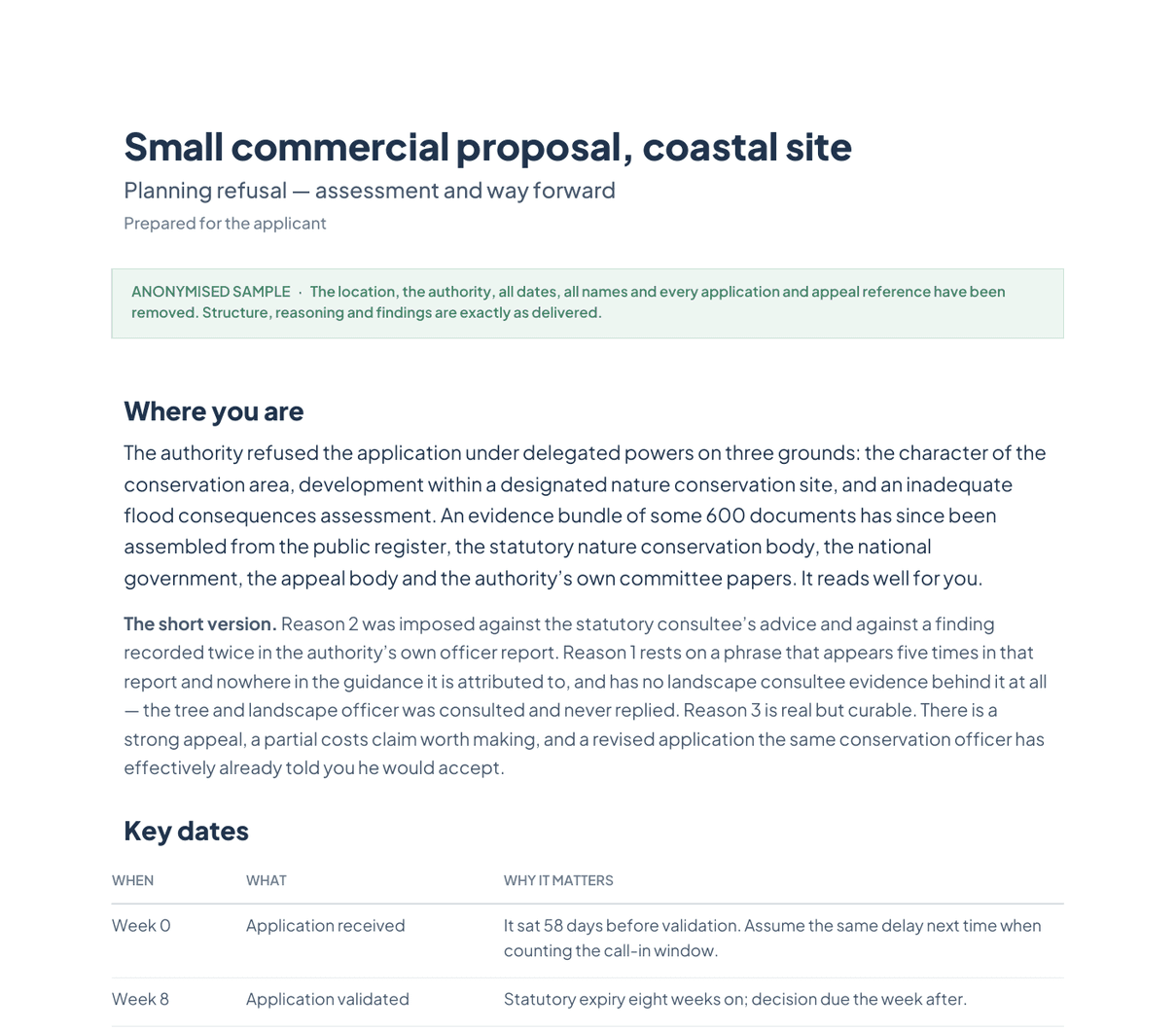
A real assessment, published with the client’s permission and fully anonymised. A small commercial proposal on a coastal site, refused under delegated powers for three reasons: harm to the character of a conservation area, development within a designated nature conservation site, and an inadequate flood consequences assessment.
Reason 2 — the strongest ground
The statutory nature conservation body advised no likely damage to the notified features. The authority's own ecologist did not object. The officer report itself records that no statutory consultee identified any negative impact.
Reason 3 — the one to fix
The conditional objection was well founded: the levels underlying the submitted assessment were not professionally surveyed. A topographic survey and a proper assessment remove the reason.
Eight findings from that one file
- A reason imposed against the authority's own recorded findingThe refusal cites development within a designated nature conservation site. The officer report names no notified feature and identifies no harm — and states, twice, that no negative impact was identified by any statutory consultee. The reasoning treats a policy presumption as a prohibition.
- A key phrase that is not in the guidance it is attributed toThe character reason turns on a five-word description of the area. It appears five times in the officer report. It appears nowhere in the adopted guidance the reason cites, which in fact groups this location with the town's commercial core. The phrase originates in one consultee response written three weeks earlier.
- A landscape objection with no landscape evidence behind itThe tree and landscape officer was consulted and did not respond. Neither did the national heritage body or the local civic society. The report asserts that two landscape character assessments apply, then assesses the proposal against neither and quotes from neither.
- A statutory consultee contradicting the premise of the reasonThe highway authority's response records that the site has previously or currently been used for commercial and tourism purposes — on the file, from a statutory consultee, contradicting the premise that the area lacks commercial activity.
- The same officer, on the same question, twiceFive months earlier the same conservation officer wrote that a proposal of this kind is not alien in such a location and that the character of a conservation area is arguably preserved by it. Four days after this refusal he gave no adverse comments to a comparable scheme elsewhere, citing its modest size and non-permanent nature.
- Supporting policies listed but never appliedOne development plan policy that expressly permits this class of development adjacent to centres is listed in the report and never analysed. A second, which designates the settlement for exactly this use, is absent altogether. The determination was therefore not made in accordance with the development plan read as a whole.
- An appeal decision against the same authority, in the same conservation areaFive months before this refusal an inspector allowed an appeal against the same authority in the same conservation area, holding that without evidence substantiating the concerns raised he had to conclude there would be no harm. The approach criticised there was repeated here.
- Four risks, stated plainlyA habitats screening that nobody has carried out and that the appeal body must do anyway. An ownership certificate whose service date appears to fall outside the statutory window. An open space designation the officer never used but which a resubmission will meet. And a committee listing on the public register that the published agenda does not explain.
Every assessment covers
- Where you are, in six lines
- Key dates, and which clock each one starts
- Prospects on each reason for refusal
- Reason-by-reason analysis against the file
- Outline grounds of appeal
- Whether a costs claim is worth making, and on what
- Risks to manage before you commit
- Two tracks: appeal, revised application, or both
- What to request, from whom, and in what order
- Key references — every instrument and decision relied on
- Basis and limits, including what is uncertain
Worth being honest about the limits
This is for you if
- You applied for a householder scheme — an extension, a loft or garage conversion, an outbuilding, an annexe, a new access — and it was refused
- You applied for something small and commercial — a change of use, a single unit, a small building, a mobile or temporary structure
- You are deciding between appealing, applying again, and letting it go
- You are about to instruct a consultant and want to know what you are instructing them on
- You have been quoted for an appeal and want to know whether the case is worth it
- Your site is in England and Wales
This is not for you if
- It is a major scheme — ten or more dwellings, or a site over half a hectare
- It is an enforcement notice, a stop notice, or anything where a deadline is measured in days
- It is listed building consent, or works to a listed building
- You need someone to act for you, submit the appeal, or attend a hearing. This is an assessment. It ends when you have the document.
- You want a guarantee of the outcome. Nobody can give you one; on an appeal the decision is the inspector’s.
- Your site is in Scotland and Northern Ireland — different systems, and I would be guessing
If you are not sure which side of that line you fall on, send it anyway. I read every submission before taking the work on, and if it is not something I can do properly I refund you in full and tell you why.
One price, paid once
- TurnaroundPDF within 5 working days of receiving your documents
- Next available startMonday 21 September 2026
- Intake checkWithin one working day I confirm I can help, or refund you in full
- What’s includedThe assessment, and one round of written questions on it
- VATNot charged. I am not VAT-registered for this work.
- PaymentCard, at the point of submission, through Stripe
Four steps, and only one of them is yours
Submit
Your refusal notice, the application reference, and a paragraph on what you applied for. Five minutes. Everything else I find myself.
Pay
£199 by card through Stripe, at the point of submission. You get a receipt and a written confirmation of the terms straight away.
Intake check
Within one working day I read what you have sent and confirm I can help. If I cannot, you are refunded in full and I tell you why, and where to go instead.
Receive
The assessment as a PDF, within 5 working days. Ask me anything about it in writing and I will answer.
Send me the refusal
Five minutes now, a PDF within 5 working days.
Next available start
Monday 21 September 2026. Your 5 working days run from then, or from the day I have everything I need — whichever is later.
What I need from you
- The decision notice (PDF)
- The application reference
- The council’s name
- A paragraph on the scheme
Not the drawings, not the whole application. If I need more I will ask, and I will get most of it from the register myself.
If your deadline is close
Put the date in the form and email hello@refusalreview.co.uk as well. I will tell you honestly whether 5 working days still leaves you enough room, before you pay.
The ones worth asking
Is this legal advice?
No. It is a planning assessment. I am not a solicitor and nothing in the document is legal advice. It is written to help you make a decision, and to brief a professional properly if you decide you need one.
Are you a chartered planner?
No. I am not RTPI-chartered and I do not hold myself out as a chartered town planner. You should know that before you buy.
What that does and does not mean: no qualification is required to prepare or lodge a planning appeal in England or Wales — the inquiry rules expressly allow an applicant to be represented by any person, and “planning consultant” is not a protected title. So the question is not whether I am allowed to do this. It is whether the work is any good. Read the sample and decide.
Where a case needs a chartered planner, the assessment says so, and tells you exactly what to brief them on — which is usually cheaper than having them work it out.
Will this get my application approved?
No, and be careful of anyone who says otherwise. What it does is tell you, on the evidence in your own file, which of the council’s reasons look weak and which look solid, and what the realistic routes forward are. Sometimes the honest answer is that there isn’t one worth the money, and the assessment will say so.
Who actually decides an appeal?
An inspector. In England, one appointed by the Planning Inspectorate; in Wales, Planning and Environment Decisions Wales, on behalf of the Welsh Ministers. They decide on the planning merits, and they are not bound by anything in my assessment or by anything the council has said. Any view I give on prospects is a view, not a forecast.
How long do I have to appeal?
In both England and Wales, twelve weeks from the date on the decision notice for a refused householder or minor commercial application, and six months for most others. The traps are that a conditional approval you want to challenge gets six months rather than twelve weeks, and that the clock runs from the date on the notice, not the date you opened it.
There are further wrinkles where an enforcement notice is involved, or where the council never determined the application at all. I check your deadline against the statutory rules for your application type and your country, and it goes on the first page. Do not rely on this paragraph for your own date — that is part of what you are paying me for.
Can I just apply again for free instead?
It depends which country you are in, and this catches people out.
In Wales, the free resubmission still exists: one further application, within twelve months of the refusal, on the same site and for development of the same character, with no fee. In England it was abolished at the end of 2023, and a resubmission now costs the full fee.
Where it is available it is often the better route, and the assessment will tell you whether you qualify and what would need to change.
Why £199? And why is it going up?
£199 is an introductory price while I build a track record. It will go to £250. The price you pay is the one shown when you submit, and it does not change afterwards.
It is priced to sit below the point where you have to think hard about it, because the whole purpose is to be the cheap decision you make before the expensive one.
What if you take the case and then can’t help?
I read every submission before starting work. If it is outside what I do, or the file will not support a useful assessment, I refund you in full within one working day and tell you why. You are not charged for the intake check, and I would rather turn work away than write something thin.
Do you contact my council?
No. I work from what is published and from what you send me. Nothing I do touches your application, your appeal, or any deadline. Where a document is not published but you are entitled to it, the assessment tells you how to request it and what to say — and you send it, in your own name.
Can I give the report to my planning consultant or solicitor?
Yes. That is partly the point. It is your document and you can share it with anyone advising you. The one thing you cannot do is resell it or publish it as your own.
What if my documents aren’t on the council’s website?
Most are, and finding them is my job, not yours. Where a document is genuinely missing — and things like pre-application advice and internal correspondence usually are — the assessment works around it and tells you how to get hold of it, including through an information request where that is the route. Any gap that materially affects a conclusion is flagged in the document itself.
Do you cover Scotland and Northern Ireland?
Not yet. They run separate planning systems with different appeal bodies, different deadlines and different fee rules. I would rather say no than guess at someone else’s jurisdiction with your money on the table.
Can I cancel?
You have a statutory 14-day right to cancel. Because the assessment is delivered in 5 working days, work has to begin inside that period, so the form asks you to confirm you want me to start now and that you understand the right ends once the assessment has been delivered in full.
Before that point you can cancel and you pay only a proportionate amount for work already done. Separately, and regardless of any of that, if I decline your case at intake you get everything back. The detail is in the terms of engagement.
What happens to my documents?
They are stored securely, used only to prepare your assessment, and deleted twelve months after delivery unless you ask me to keep them for longer. I do not sell or share them, and I do not use your case as a public example without asking you first — the sample on this page is published with the client’s permission and with every identifying detail removed. The privacy policy sets it out in full.
Find out what your file actually says
£199. A PDF in 5 working days. Refunded in full if I cannot help.
Get started